Tuesday, June 5, 2012

N172 Brooklyn Minis


Some of my favorite cards are the 1887 N172 Old Judge Brooklyn Minis.

Goodwin and Company began to issue the largest set of baseball cards ever offered at the time when they began to put cards in their Old Judge cigarette packs in the fall of 1886.  They continued to issue more and more cards including players, managers, umpires, mascots and an owner into 1890.  Many of the cards were the same pose with a team change following trades.  In addition, some players had many different poses and some had just a few.  In total almost 2500 different poses/variations are known with 521 different subjects. 

I'd like to focus on the just the Brooklyn Minis right now though.  There are 48 regular Brooklyn poses known which accounts for 2 full sheets.  So we can assume there can not be more than this amount of minis, however, to date there have been less than half of this number verified.  In fact, Brooklyn Minis are quite rare and desirable to Old Judge collectors. 

What is a Brooklyn Mini anyway?  It is a normal sized Old Judge card with the image of the player cropped smaller and having a much larger border around the image.  To understand how they were created we have to look at the production of the Old Judge cards themselves. 

Goodwin took cabinet photos of the players and cropped them down to a smaller size (still larger than the cards) and placed them in a grid of four rows with six cards in each row.  Then they added a mat (a die-cut board which framed the images) to the grid and placed the name plates, Old Judge banner ads, and copyright lines to the images.  From there, they would take another photo of the entire grid and when they delevoped that photo, they had an uncut sheet of cards.  When you look at a normal 1887 N172 you can see the shadows under the mat that was added to the grid (see image).

How does this relate to Brooklyn Minis?  Well, all Old Judge cards depicted players that were photographed in a studio in front of a background.  However, the photographer taking the Brooklyn photos took the photos outside and, when he did so, he took them from a farther distance away from the player than those taken in studio settings.  So, when Goodwin was preparing the grid for the Brooklyn cards, they decided to crop the photos a little tigher than the rest of the cards so the players would still be the same size on the finished card.  Then they took the photo of the completed grid at a closer distance to create the same size uncut sheet as the non-Brooklyn sheets. 

By doing this, they could create normal looking Brooklyn cards.  The differences were that the Old Judge banner ad and the name plates appeared larger on the Brooklyn cards because they were being photographed from closer than on the other cards.  The copyright line looked about the same because they used a smaller copyright cutout. 


Well this explains how we have normal sized Brooklyn cards in the set.  How did we end up with minis though?  Goodwin didn't always print sheets in just team composites.  They often printed sheets with players from different teams also.  So whenever they printed a sheet that included some Brooklyn players among others, the smaller cropped Brooklyn images ended up being photographed from farther away and ended up smaller on the cards.  Goodwin even added a second mat to gap the space between the smaller image and the larger mat used for the other players.  You can see four Brooklyn Minis in the sheet above as the first four cards in the top row.  Notice the larger borders around the image, the outside backgrounds, the shadows of the second mat around the images and the smaller player size in relation to the other cards on the sheet. 


Hopefully all of this makes sense the way I've written it.  There is a wonderful article written by Jay Miller and Joe Gonsowski about this all in issue #3 of Old Cardboard magazine.  It goes into more detail than I have here and I highly recommend it.

Enjoy the hobby all...it's a super one.

Sunday, June 3, 2012

1914 B18 Blankets


The 1914 B18 Blanket set is an interesting one for several reasons.

First, they aren't cards but are instead squares of felt.  The measure about 5 1/2 inches on each side with a picture of the player surrounded by an infield and two pennants.  There are 91 felts in the set, not including all the different color variations, from 10 major league teams.  They can have different basepaths, bases, pennants or even infield colors. 

They were packaged with packs of Egyptienne Straights Cigarettes and were folded in half twice, placed in an envelope and attached to the packs using an adhesive strip.  Sometimes you will find some remnants of the adhesive strip still attached to the blankets.  Packs of Egyptienne Straights were square in shape, so folding the blanket in this way made them fit with the packages. 

The blankets are also often found sewn together into quilts or perhaps pillow cases as was normal for this type of give away back then.  Some collectors have taken quilts apart to sell off the individual squares and you will find some of them that have the holes in the borders from being sewn together. 

The most difficult ones to find, and the most expensive, are the ones with red infields.  These are extremely rare and do not show up often.  Only Boston and Detroit players are found with the red infields by the way.  The Ty Cobb red infield version is, of course, the best blanket in the set.

I was lucky enough to find my two blankets in an antique mall outside of Denver, CO years ago.  They were pinned together in the bottom shelf of a cabinet display for only $10 for the pair.  I snatched them up right away.  Here are my two.


Enjoy the hobby all...It's a fantastic one.


Saturday, June 2, 2012

Just a Few Cool Cards to Share

I just wanted to do a quick post sharing a few cards I think are pretty cool.

I wanted to include at least one card from my collection so let's start with this 1949 Remar Billy Martin.  It shows a very young Billy Martin playing for the Oakland Oaks of the Pacific Coast League before he became a legend of the major leagues.


These next two are truly amazing cards.  They are the 1934 and 1935 Zeenut cards of Joe DiMaggio.  The 1934 is the first card that pictured Joe and he is playing for the San Francisco Seals of the Pacific Coast League.  Both of these examples have their coupon still intact at the bottom of the card which is quite rare for this issue.  They both sold at auction for over $14K each.


The batting pose is the 1934 issue and the throwing pose is the 1935 issue.

The last card I wanted to share is just hilarious.  It's the 1887 N172 Old Judge card of Charles "Old Hoss" Radbourn.  Specifically the pose where he is flipping us the bird.  Check it out, he calmly throws the finger out before the picture is snapped and we have ourselves one awesome card. 

For those of you who aren't familiar with Old Hoss he was regarded as one of the best pitchers of his time.  He pitched underhand, as was customary back then, and he would pitch using different arm angles for his deliveries.  He was one of the first to do this on a regular basis to try to fool batters.  He also hit the first walk-off home run in major league history in an eighteen inning 1-0 game in 1882.  He was elected into The Baseball Hall of Fame in 1939.


Well, that's it for now.  I just wanted to share these with you in case you had never seen them before.  Hopefully you liked them.

Enjoy the hobby all...it's an awesome one.


Friday, June 1, 2012

The Merkle Ball

I have wanted to do this post for the past couple of years ever since REA had this ball in their 2010 Auction.

This ball was part of one of my favorite plays in all of baseball; The Merkle Boner Play.

Image Courtesy REA
It was September 23, 1908 when the Cubs were playing the Giants at the Polo Grounds.  Jack Pfiester was facing Christy Mathewson in a great pitcher's duel and the score was tied 1-1 going into the bottom of the ninth.  Fred Tenney had a bad back that day and John McGraw put in a 19 year old kid named Fred Merkle.  It was the first game Merkle had started all season and would be a game he would never forget. 
Image Courtesy REA

With Moose McCormick on first base, Merkle came to the plate and hit a two out single to right field sending McCormick to third.  Al Bridwell stepped to the plate with the winning run on third and Merkle on first.  He swung at the first pitch he was offered and sent a line drive to center for a base hit and McCormick came home with the winning run. 

Image Courtesy OldCardboard.com
The crowd went crazy and started to flood onto the field as was usual back then.  Here is where Fred Merkle made his mistake.  He headed for the clubhouse after the hit by Bridwell and failed to touch second base.  Johnny Evers of the Cubs got the ball and forced him out at second base.  Now the crowd was already all over the place and the umps, Hank O'Day and Bob Emslie, ruled Merkle out and the game a tie. 
Now, because they tied this game, they ended the season tied for first and had to play a make up game to decide the pennant at the end of the season.  The Giants lost the make up game and subsequently the pennant.  Merkle was blamed and he never lived it down.

The ball that Evers held in his hand on that very play is the ball that was auctioned off in the 2010 Robert Edwards Auction.  It sold for $76,375.00.  This is a Hall of Fame caliber artifact and an amazing piece of baseball history.  To see it at auction was amazing to me and I will never forget when I first saw it in the catalog.  I was floored.

Here is a link to the full story from the REA website: Full Story

Enjoy the hobby all...It's a great one.

Sunday, May 27, 2012

Trading Cards Again


Remember trading cards when you were younger?  I do.  Unfortunately I don't know anyone anymore who collects cards like I do.

I took quite a break from the hobby in the last year and a half or so and I've been getting back into it more and more the last few months.  Hence the posts starting on my blog again.  Anyway, one of the things that I have gotten into recently is the idea of trading again.  I found some nice trading groups online and am hoping to make some new hobby pals and start trading to build some sets.

I put a new link in the right sidebar at the top of my blog that links to a website I set up just for trading.  If this is something you do, please check it out and hopefully we can trade something.  Anything.  I don't care too much at this point what I'm trading, I just want to get some good experience under my belt, meet a few people and maybe get into a trading group or two. 

I've decided to focus on sets I already had some cards for and that led to the following:

  1. 1954 Topps
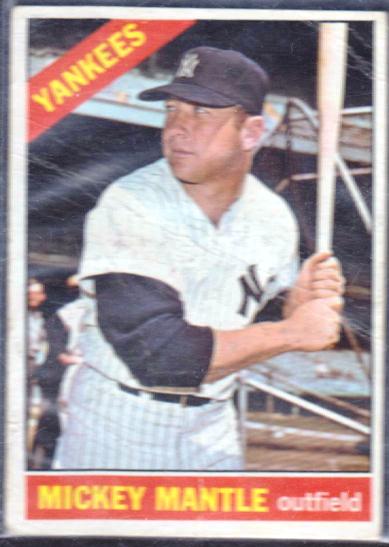
  2. 1966 Topps
  3. 1969 Deckle Edge
  4. 1970-79 Topps
  5. 1981 Topps
I've also put a few others on the list but these are my priorities for now.  Of course, I'm still very into prewar cards and would trade those as well, but my new site is more dedicated to postwar stuff. 

So come on guys and gals, let's trade something!

Enjoy the hobby all...it's a great one.

Things You Should Know :: '33 Goudey & Miller


Continuing with my posts on Things You Should Know about the prewar hobby, I'd like to talk about two cards from 1933 sets.  One of which was actually not even printed in 1933. 

I'm talking about the 1933 Goudey (R319) Napoleon Lajoie and the 1933 George C. Miller (R300) Ivy Miller cards.  Both of these cards are rare and the stories behind them are what you should know.  Let's begin with the Lajoie.

In 1933 Goudey created one of the best sets of the era.  The set has four Babe Ruths and two Lou Gehrigs in it.  Plus many other greats of the time.  But any kid trying to complete the set back in 1933 had one huge problem on their hands.  Card number 106 seemed impossible to find. And, in fact, it was impossible to find.  Goudey didn't make a card 106, so everyone had a hole in their set and would keep buying packs over and over again in vain trying to finish off their sets.

Some collectors were so upset that they mailed off letters to the Goudey offices in Boston requesting the missing card.  Well, Goudey must have gotten enough letters because when they produced the 1934 set, they included a card number 106 of Napoleon Lajoie and sent them to those people who asked for it.  Due to this method of distribution, the card is extremely rare today and is obviously the key card of the 1933 set.   Notice that the card has the same baseball scene in the background as is seen in the 1934 Goudey set.

The second card I want to discuss is the 1933 George C. Miller Ivy Andrews.  Unlike the Lajoie of the 1933 Goudey set, this card was actually available in packs.  It was advertised that a collector could send in a complete set of these cards in exchange for either and baseball, a glove or a ticket to a major league game.  They collector would get his cards back with a cancellation in the form or either diamond holes punched in them or the bottom of the card trimmed off.  This way, they could not be used a second time for redemption.

The company wanted to limit the number of prizes is was going to have to give out, so they severly shortprinted the Ivy Andrews card.  By doing so, they could sell a lot of cards without having to give away that many prizes.  It is because of this that so few Ivy Andrew cards exist today and when you do see one, it will likely be cancelled with the bottom of the card trimmed off.

These are two more cards you need to know if you're in the prewar baseball card hobby. 

I hope you enjoy my blog and if you have any ideas for topics you want to see, please let me know. 

Enjoy the hobby all...it's a wonderful one.

Saturday, May 26, 2012

Prewar Hobby :: Things You Should Know


If you are going to be in the prewar baseball card hobby there are many things you should know. A broad knowledge of the hobby can only help you as you embark on your endeavor.

There are many collectors out there who have been in the hobby for years who may still not know anything about cards from sets that they don't collect. They may be extremely knowledgeable about the sets they do collect, and I think that is great, but when it comes to other sets they may not know a thing. I think it's always good to know as much as possible, even if you don't collect certain cards.

Before going any further, let me be clear by saying that I am not an expert in any prewar set. I do however know a decent amount about these cards in a broad sense. And I just wanted to share some of the basic stuff that you should know if you're going to collect prewar cards. Many of you may think this is all common knowledge and you may already know all of it, but this is more for those collectors who may be new to the hobby or just never heard of some of this stuff.

Let's begin with the 1909-11 T206 set, also know to collectors as "The Monster".  It's a big set at 524 cards.  I'm not going to get into too much detail here about this set as books have been written about it already.  I just want to touch on some of the main points.

Image courtesy OldCardboard.com
Many people consider their sets complete at 520 cards due to the difficulty in obtaining the last four cards conveniently known as "The Big Four".  These include the following:
  1. Honus Wagner - The Holy Grail of baseball cards. This is a rare card and estimates vary regarding how many exist. For this post I will say there are around 50 of them out there.
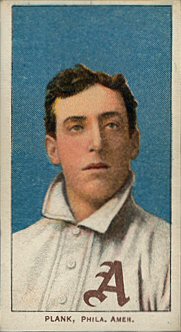
  2. Eddie Plank - Another rare card in the set.  I don't have an estimate for how many of these are out there.
  3. Sherry Magee (Magie) error card - Magee's name was misspelled early on in the print run as Magie and was caught quickly and corrected.  The resulting error card is a tough one to come by, but not nearly as difficult as Wagner or Plank.
  4. Joe Doyle, NY Nat'l - I did a post about this card in 2008, you can read it HERE.
Another fact you should know about the T206 set is that there are 16 different brands advertised on the reverse of the cards.  Not all fronts can be found with all the different backs however.  The sixteen brands are (in alphabetical order, not scarcity order):

Image courtesy T206baseball.com
  1. American Beauty
  2. Broad Leaf
  3. Carolina Brights
  4. Cycle
  5. Drum
  6. El Principe de Gales
  7. Hindu
  8. Lenox
  9. Old Mill
  10. Piedmont
  11. Polar Bear
  12. Sovereign
  13. Sweet Caporal
  14. Tolstoi
  15. Ty Cobb
  16. Uzit
There are currently debates in the hobby regarding whether or not the Ty Cobb back is really a T206 back and whether or not Coupon (mainly type 1) backs should be included as T206 cards.  One thing to know about the Ty Cobb back is that it is only found with a Ty Cobb Red Background Portrait front and it is always printed in green.  There are reprints out there with the ad printed in blue and these are always fake.

That's it for my first post about things you should know.  I'm going to have many more of these so hopefully you enjoyed it.  I look forward to getting back into my blog as I took quite some time off in the last year. 

Enjoy the hobby all...It's a great one.